 Jaguar F-Type R Coupe
The
all-aluminium Jaguar F-Type Coupé - the most dynamically capable,
performance-focused sports car that Jaguar has ever produced - is
available in three versions: F-Type R, F-Type S and the F-Type. The range-topping Jaguar F-Type R Coupé is powered by Jaguar's 5.0-litre supercharged V8 engine in 550PS/680Nm tune, delivering acceleration to 60mph in 4.0-seconds, and a top speed of 186mph (electronically limited).
The F-Type S Coupé and F-Type Coupé are powered by Jaguar's 3.0-litre V6 supercharged petrol engines in 380PS/460Nm and 340PS/450Nm forms respectively, giving 0-60mph in 4.8/5.1-seconds and top speeds of 171/161mph.
The Jaguar F-Type Coupé embodies the uncompromised design vision of the stunning Jaguar C-X16 concept sports coupé that debuted at the 2011 Frankfurt Motor Show, its dramatic cabin-rearward stance being defined by three heartlines. The first two heartlines - shared with F-Type Convertible - form the muscular front and rear wings, the third heartline being the sweeping Coupé roof profile which provides an unbroken silhouette while emphasising the visual drama of the tapered cabin sitting between powerful rear haunches.
"The F-Type Coupé provides its driver with a unique sports car experience. It combines seductive design with cutting-edge technology and performance which is truly breathtaking. Engaging, precise, intuitive and alive - it is the definitive sports Coupé." Phil Popham, Group Marketing Director, Jaguar Land Rover

Jaguar's expertise in aluminium technology has enabled the design
vision for the F-Type Coupé to be delivered in a lightweight yet
extremely strong bodyshell. Torsional rigidity for all F-Type Coupé
variants is 33,000 Nm/degree - greater than in any previous production
Jaguar - this rigidity providing the basis for excellent dynamic
attributes.
The F-Type Coupé's body side is made from a
single-piece aluminium pressing, probably the most extreme cold-formed
aluminium body side in the automotive industry, eliminating the
requirement for multiple panels and cosmetic joints. The roof panel
itself is available in either aluminium or panoramic glass form. A
deployable rear spoiler sits within the tapered shut-line of the F-Type
Coupé, while slim, wrap-around LED lamps flank a beautifully engineered
tailgate, with optional powered open/close functionality.
To
deliver assured, progressive handling in line with its 550PS output, the
range-topping Jaguar F-Type R Coupé features a bespoke suspension
set-up and new dynamic technologies. These include a second-generation
Electronic Active Differential (EAD) and - for the first time on a
Jaguar - Torque Vectoring by braking, these systems working in parallel
to provide immediacy of response and exploitable handling. The EAD
system automatically redistributes engine torque between the rear wheels
to ensure excellent on-the-limit control, while Torque Vectoring by
braking intelligently applies precisely metered braking force to the
inner wheels as necessary during cornering to enhance agility. Sports
suspension with Adaptive Dynamics damping and Configurable Dynamic Mode
further enhance the F-Type R's immediacy of response, providing an
exhilarating and involving driving experience.
F-Type R and F-Type
S Coupé models also have the option of Carbon Ceramic Matrix (CCM)
brakes which offer absolute consistency of performance and excellent
fade resistance, as well as a total unsprung-weight saving of 21kg.
Every
F-Type Coupé model utilises Jaguar's eight-speed close-ratio Quickshift
transmission which is optimised for sporting performance, with full
manual sequential control from the central SportShift selector or
steering wheel-mounted paddles.
The F-Type Coupé range complements
the existing three-car F-Type Convertible model line-up; the V6-engined
F-Type (340PS) and F-Type S (380PS), and the 495PS F-Type V8 S.
DESIGN AND STRUCTURE


Visual
appeal is fundamental to Jaguar and, as such, the F-Type Coupé is
immediately recognisable, building on the design of the stunning C-X16
concept sports Coupé and the F-Type Convertible - winner of the 2013
'World Car Design of the Year' award.
"Creating a sports Coupé is
the purest of design tasks, and also the most challenging; get it right
and aesthetically the result will be as dynamic as the car should be
rewarding to drive. In F-Type Coupé, I believe we've got it right. The
purity of the C-X16 concept has been retained without compromise; the
F-Type Coupé's long bonnet, low roofline and tapering cabin inspire me
every time I see it." Ian Callum, Director of Design, Jaguar
The
F-Type Coupé visual message is defined by three key 'heartlines', that
visual message beginning with the formidable grille. It is from the twin
'shark gill' openings that sit either side of the grille that the
essential first heartline - which mirrors the design of the F-Type
Convertible - flows and begins to take shape. Running up through the
headlamp, and accentuated by the LED 'J blade' daylight running lamps,
the line then arcs up over the front wheelarch before dropping elegantly
as it runs through the door, washing out into the muscular rear haunch.
The
Coupé's second heartline, also shared with the Convertible, begins at
the rear edge of the door, swelling outwards and upwards to create a
visually strong wheelarch, emphasising the car's rear-wheel drive
layout, before dropping vertically through the tail lamp.
The
third heartline forms the Coupé's dramatic, cabin-rearward, sweeping
roof profile. Providing an unbroken silhouette, it highlights the visual
drama of the tapered cabin nestled between the powerful rear haunches.
The distinctive side window graphic, finished as standard in bright
aluminium, accentuates both the compactness of the car and the roof
profile.
Jaguar's expertise in aluminium vehicle architecture has
been essential in enabling both the F-Type Coupé's uncompromised design
aesthetic, while delivering the fundamental dynamic attributes -
essential to any sports car - of low mass and an extremely rigid body.
Measuring 33,000 Nm/degree, the F-Type Coupé is the most torsionally
rigid production car Jaguar has ever built.
A fundamental
requirement for excellent dynamic attributes, delivering that rigidity
figure required some innovative engineering solutions in order to
maximise strength without impacting on the design vision. Due to the
lack of B-pillars, Jaguar's engineers were presented with the challenge
of keeping the design's sleek, pillarless, low roofline - combined with
the need to create the optimum amount of interior space - while still
achieving the necessary rigidity and strength targets. The solution was a
high-strength, hydro-formed aluminium alloy beam which runs from the
front of the A-pillar through to the back of the D-pillar, through the
door opening line and back to the rear quarter window.
The F-Type
Coupé is available with either aluminium or panoramic glass roof panels
that are bonded into the main roof structure - torsional rigidity is
identical regardless of which roof is fitted.
The F-Type Coupé's
dramatic body sides are single-piece aluminium pressings - probably the
most extreme cold-formed aluminium body side outer panels in the
automotive industry. These exceptionally deep-draw aluminium pressings
have totally eliminated the requirement for joints in the panel surface.
The body side panel is fabricated from high-strength and formable AC600
aluminium, which has also been used for structural reinforcement - both
engineering firsts for Jaguar. The use of AC300 T61 aluminium in the
body structure of the car provides additional strength thanks to its
energy absorbing properties, ensuring maximum occupant protection.
In
order to achieve the required aesthetic at the rear of the car, the
F-Type Coupé features a hidden rear spoiler that sits within the tapered
shut-line of the tailgate, and rises at speed in order to balance front
and rear lift. The spoiler automatically rises at 70mph and lowers when
the speed drops below 50mph, reducing lift by up to 120kg.
The
width of the tail is emphasised by the slim, full-LED lamps that wrap
all the way around the wings almost to the trailing edge of the rear
wheelarches. These lamps feature hidden-until-lit technology, appearing
solid until one of their functions is activated. The F-Type Coupé also
features a 'ribbon of light' LED high-mounted stop light, which is
hidden at the top of the beautifully engineered tailgate. The tailgate,
available with powered open/close functionality, is made from composite
materials, the boot-volume itself being up to 407-litres.
Aluminium
forms a significant part of Jaguar's commitment to sustainability with
up to half the content of the body coming from recycled metal. In
addition, the F-Type Coupé's structure is exclusively riveted and bonded
- this manufacturing process emits up to 80% less CO2 compared to that
from welding a comparable steel structure. Jaguar is also rolling out
its closed-loop aluminium recycling system to its suppliers, ensuring
all offcuts of metal from the manufacturing process are reused.
F-TYPE R COUPE
The
Jaguar F-Type R Coupé represents the pinnacle of the F-Type range.
Powered by Jaguar's 5.0-litre supercharged petrol V8 all-aluminium
engine in 550PS and 680Nm form, the F-Type R Coupé achieves headline
figures of 0-60mph in 4.0-seconds with an electronically limited top
speed of 186mph, 50-75mph taking a mere 2.4-seconds. CO2 emissions are
259g/km.
"The F-Type R Coupé represents the pinnacle of Jaguar's R
Performance range - its power, performance and immediacy of response
will reward the most enthusiastic of drivers while, most importantly,
we've engineered the chassis to provide exploitable handling that
inspires confidence. It's precise, and it's fast… a true driver's car."
Mike Cross, Chief Engineer, Vehicle Integrity, Jaguar
The R
Coupé's supercharged engine delivers not only exhilarating performance
but also tremendous efficiency thanks to the technologies incorporated
into it, including spray-guided direct injection (SGDI) and dual
independent variable cam timing (DIVCT). The high-pressure die-cast
lightweight aluminium block is stiffened with cast-iron liners and
cross-bolted main bearing caps, providing refinement to match its power.
The four-valve cylinder heads are constructed from high-grade, bespoke
aluminium, between them sitting the Roots-type twin vortex supercharger
fed by two intercoolers, which feature their own water-cooling circuit
to reduce the temperature of the pressurised air, thereby optimising
power and efficiency.
The torsional rigidity of the Jaguar F-Type R
Coupé's aluminium structure has ensured the best possible basis for
offering the connected feel, agility and engaging driving experience
expected of a Jaguar sports car. Every response, from the steering to
the gearchange, throttle, brakes and the all-round double wishbone
suspension, has been finely honed to be accurate, involving and
immediate.
The F-Type R Coupé is fitted with Jaguar's Adaptive
Dynamics system that actively controls vertical body movement, roll and
pitch rates. The system continuously monitors driver inputs and the
attitude of the car on the road, adjusting damper rates accordingly up
to 500 times a second to optimise stability. For the F-Type R, the
Adaptive Dynamics controlling software has a bespoke tune, working in
tandem with revised spring rates all-round to deliver consistent,
progressive and exploitable handling. Spring rates are increased by 4.3%
at the front and 3.7% at the rear (compared to F-Type V8 S
Convertible).
Engaging Dynamic mode delivers an even more focused
driving experience thanks to enhanced body control through firmer
damping rates, increased steering weighting, faster gear changes and
sharper throttle response. In the F-Type R Coupé, Dynamic mode is
configurable as standard via the central 8in touchscreen, allowing the
driver to select and save settings according to their preference.
In
addition to the fundamental suspension tune changes, the Jaguar F-Type R
Coupé features a new second-generation Electronic Active Differential
which, for the first time on a Jaguar, works in conjunction with Torque
Vectoring by braking. Together, the two systems ensure agility at all
speeds and exploitable on-the-limit handling.
The F-Type R Coupé's
Electronic Active Differential (EAD) builds on the progressive handling
advantages of a mechanical limited-slip differential by intelligently
controlling the amount of driveline torque fed to each wheel. The EAD
utilises an electric motor which operates a multiplate clutch; by
rapidly and continuously analysing a range of electronic inputs it is
able to immediately vary torque transfer to each driven wheel to
maximise traction in any condition.
The EAD system fitted to the
F-Type R Coupé features a highly sophisticated second-generation
controller. It continuously estimates surface friction, comparing that
to the driver's torque demand and delivering accurate locking torque as a
result. A new handling controller also means the EAD has the ability to
match the car's response more accurately with the driver's inputs
during both on-power understeer or off-power oversteer conditions.
Working in parallel with the Torque Vectoring by braking system, the
controller is capable of reacting to the ECU's torque request - ranging
from open to full locking torque - in under 200 milliseconds.
Torque
Vectoring by braking - a standard feature on F-Type R Coupé - applies
finely metered braking torque individually to the inner wheels as
necessary, helping to turn the car into corners more precisely. Using
the Jaguar F-Type R Coupé's array of electronic sensors, the Torque
Vectoring system determines when corner entry speed may induce
understeer. It then calculates the level of brake force needed to
correct the car's direction and, via the ABS system, applies that
precise braking force to individual inner wheels as necessary. Torque
Vectoring by braking works at a subtle level, both correctively and
predictively, finely adjusting the trajectory of the F-Type R Coupé for
optimal handling.
The F-Type R's EAD and Torque Vectoring by
braking systems - which work together with the car's Dynamic Stability
Control system - complement each other to optimise traction, cornering
ability and, most importantly, to maximise steering feel and agility.
Torque Vectoring by braking works to fine-tune trajectory around a
corner, and as the car is pushed further to its limits, there is a
natural, seamless transition to EAD.
As a result, the use of
available grip is always optimised, enabling the F-Type R Coupé to carry
more speed both into, through and out of corners, while delivering
precision handling during high-speed manoeuvres.
The Jaguar F-Type
R Coupé uses Jaguar's Super Performance braking system as standard.
This system features 380mm front and 376mm rear discs - with red or
black painted calipers. Brake cooling is optimised via under-body
channelling of air, the air-flow being derived through the use of
Computational Fluid Dynamics analysis.
The R Coupé is also
available with optional Carbon Ceramic Matrix (CCM) brakes which offer
consistent performance and excellent fade resistance even during extreme
performance driving conditions, while retaining the precise pedal feel
of the standard system and extending disc life in everyday driving use.
The
F-Type's eight-speed 'Quickshift' transmission has been recalibrated to
make the best use of the F-Type R Coupé's 550PS engine. Its eight,
closely-stacked, sporting ratios help to fully exploit the engine's rev
range and ensure that it remains within its optimal power band with
every gearchange. Manual control is available to the driver at any time,
using either the steering wheel-mounted paddles or the central
SportShift selector.
The F-Type R Coupé's switchable Active Sports
Exhaust system - with its signature quad, outboard-mounted tailpipes -
takes the aural excitement delivered by the 550PS engine to new levels.
It offers an authentic, rich sound, developing to a howling crescendo as
the upper limits of the rev range are reached. The system uses
electronically controlled bypass valves in the rear section of the
exhaust which are mapped to open according to a range of parameters,
effectively altering the exhaust gas routing into a free-flowing
straight-through arrangement to both reduce back pressure and enhance
sound quality. Selecting Dynamic mode also opens the bypass valves, an
optional override button enabling further driver control of the system.
The
Jaguar F-Type R Coupé's aerodynamic bodywork - gloss black front vanes
beneath the shark gills and flat side sill extensions - aid its
stability at the very high speeds of which it is capable. As standard
the R Coupé's window finishes are highlighted in bright anodised
aluminium along the frames of the side glass, with the grille surround
and side air vents in bright chrome, while the optional Black Pack adds
gloss black window finishers, gloss black side power air vents and a
gloss black grille surround. The front splitter, side power vents, door
mirrors casings, bonnet power vents and engine cover are also available
in carbon fibre.
20in 'Gyrodyne' wheels in silver finish are
standard on the F-Type R Coupé, while a dark grey and diamond-turned
version is optional. As on any F-Type specified with 20in wheels, the
F-Type R Coupé is available with optional ultra-high performance tyres
which, with a unique tread pattern, offer additional steering precision,
and increased levels of grip for the enthusiast driver.
Interior
Like
all models in the F-Type range, the R Coupé's driver-focused cabin
clearly conveys the car's pedigree and sporting prowess, through a
combination of taut, technical styling, involving interfaces and premium
materials and textures.
The Jaguar F-Type R Coupé's Performance
seats have inflatable side-bolstering and prominent wings for support
during high-speed cornering. The seats are finished in premium leather,
with the 'R' logo embossed on the headrest. A pure 'Jet' interior
colourway is offered with three options of contrast stitching - Ivory,
Red or Firesand - on the instrument panels, door casings, grab-handle
highlight and cubby box. There are a further three sporting options on
the Jet seats - Ivory, Camel or Red duo-tones, each with
similarly-matched contrast stitching.
The Jaguar F-Type R Coupé's
premium trim also includes leather on the instrument panel and binnacle,
armrests, door inserts and the centre console. Leather or Suedecloth
headlinings are optional. The driver-focused cockpit conveys its
sporting intentions with a small-diameter, flat-bottomed steering wheel
wrapped in Jet leather with the R logo. A round wheel is a no-cost
option.
A new, full leather and Suedecloth Jet interior (with
Cirrus contrast stitch) is also optional on all derivatives. Suedecloth
is used on the seat facings, door casings, instrument binnacle pods and
headlining - and can also be combined with a Suedecloth steering wheel.


F-TYPE COUPÉ AND S COUPÉ
The
Jaguar F-Type Coupé is also available in two V6-supercharged powered
petrol variants, both driving the rear wheels through eight-speed
Quickshift transmissions; the F-Type Coupé and the F-Type S Coupé.
Featuring the same rigid yet lightweight Coupé bodyshell as the F-Type
R, and combined with a finely tuned focus on ride, handling and
performance, both the F-Type Coupé and F-Type S Coupé are true drivers'
cars.
The F-Type Coupé is powered by Jaguar's 3.0-litre V6
supercharged petrol engine in 340PS/450Nm tune, and is capable of
0-60mph in 5.1-seconds with an electronically limited top speed of 161
mph. Standard features include Dynamic Mode, sports exhaust - both V6
models use twin, centrally-mounted tailpipes - sports suspension and
Jaguar's Performance Braking system (354/325mm discs front/rear) with
silver calipers. The F-Type Coupé is fitted as standard with 18in Vela
wheels, partial leather/Suedecloth sports seats and a leather steering
wheel with black paddles.
The F-Type S Coupé, powered by Jaguar's
3.0-litre V6 supercharged petrol engine in 380PS/460Nm tune is capable
of 0-60mph in 4.8-seconds on its way to an electronically limited top
speed of 171 mph. It features Dynamic Mode, Dynamic Launch, Active
Sports Exhaust, sports suspension with Adaptive Dynamics, Jaguar's High
Performance Braking system (380/325mm discs front/rear) with red
calipers and a mechanical limited-slip differential. Both Jaguar's Super
Performance and CCM braking systems are optional. The F-Type S Coupé is
fitted as standard with 19in Propeller wheels, leather sports seats and
a leather steering wheel with Ignis paddles.
All F-Type models -
Coupé and Convertible - are equipped with Jaguar's Intelligent
Stop/Start system which, when conditions allow, automatically shuts down
the engine when the car comes to a halt and the driver's foot is on the
brake pedal. When the brake is released, the system can restart the
engine in less time than it takes for the driver's foot to move from the
brake to the accelerator. The system offers fuel economy and emissions
benefits of up to 5 per cent.
The F-Type Coupé model range is
available with three audio systems, two of which come from globally
recognised British experts Meridian. These offer either 10 or 12
loudspeakers with outputs of 380W and 770W respectively. The Meridian
systems benefit from the company's huge experience in digital signal
processing to create audio reproduction that is second to none. The top
of the range offering also features Meridian's proprietary Trifield
technology, which delivers an authentic and consistent surround sound to
both occupants.
CARBON CERAMIC MATRIX BRAKES
The
F-Type R and S Coupé models have an exclusive option of Carbon Ceramic
Matrix (CCM) brakes. Vivid yellow monoblock calipers - six-piston at the
front and four-piston at the rear - grip 398mm front and 380mm rear
brake discs made from a matrix of carbon fibre and ceramic, which is
extremely hard and highly resistant to wear.
The CCM system offers
consistent performance and excellent fade resistance even during
sustained extreme driving conditions, while retaining the precise pedal
feel of the standard system. Reduced wear and tear in day-to-day driving
also means extended disc life.
CCM brakes offer considerable
weight savings over standard steel brakes - the overall 21kg reduction
in unsprung weight further enhancing handling dynamics. As CCM brakes
generate more surface temperature than steel brakes, open-air intakes on
the bumper and deflectors on the anti-roll bar direct increased airflow
to the braking system - the attention to detail even extending to the
use of new, heat-resistant valve caps.
CCM brakes feature a
pre-fill system function that applies a low brake pressure to all four
calipers when the throttle is released - and before the brake pedal is
pressed again. The pre-fill system ensures a consistent brake pedal
feel, and is tuned for speed proportionality. This means that at higher
speeds it will give a consistently sharp, confidence-inspiring response,
while at low car park type speeds the system will provide a more
comfort-biased pedal feel.
Specify CCM brakes and the F-Type R or S
Coupé will come with 20in 'Storm' wheels. As standard these are in a
satin grey anthracite finish, but an optional, forged version with gloss
black/diamond-turned finish is offered.
Citroen Aircross Concept
As the
brand celebrates 50 million vehicle sales since its creation some 95
years ago, Citroën is unveiling a surprising, creative and bold new
concept car ahead of the 2015 Shanghai Motor Show.
The new Citroën Aircross concept confirms the brand's ability to develop its new positioning, which is already:


- INTERNATIONAL: The Citroën Aircross illustrates the brand's international ambitions, building on the success of the New C4 Cactus, with a body style intended for worldwide sale.
- DIFFERENT: The Citroën Aircross concept
offers new design codes whilst respecting the essential characteristics
of an SUV. Drawing on the product and styling traits of C4 Cactus, the
body design and cabin ambience express a sense of modernity and a unique
'feel good' spirit. This new concept car illustrates Citroën's ability
to assert its identity in all vehicle segments.
The Citroën Aircross concept successfully builds on the achievements of the C4 Cactus with:

- A
SINGULAR DESIGN PHILOSOPHY: Blending power and positive energy, the
Citroën Aircross is a protective and welcoming SUV. This resolutely
optimistic vehicle casts off any sense of aggression in favour of:
- A pure and engaging personality, through the overall balance of the body styling underscored with flowing forms that are punctuated by strong graphic components, including 'Alloy Bumps' and 'Air Signs'.
- The positive design is heightened by vibrant orange-red paintwork symbolising energy and serenity, with innovative materials denoting robustness.
- A styling approach emphasising functionality and aerodynamics.
- AN INVITATION TO TRAVEL: The cabin offers an immediate sense of comfort. Everything inside the Citroën Aircross is designed to promote occupant well-being. In addition to the physical comfort provided by the broad and generous seats, well-being is enhanced still further with the use of new materials and a blend of light, invigorating colours. The pure, horizontal lines of the exterior suggest a feeling of interior space, while the ample geometric shapes of the uncluttered interior offer a combination of appealing aesthetics and functionality. The Citroën Aircross concept represents a new approach to travel with specially designed storage compartments and the use of luggage style 'straps' in a fresh and contemporary cabin that invites passengers to take to the road together.
- TECHNOLOGICAL INTELLIGENCE: With a focus on
practicality, occupants are able to choose between a shared and an
individual travelling experience. The concept car is equipped with two
12-inch HD screens, one of which moves across the dashboard so it can be
seen by more than just one passenger. Each seat is equipped with
speakers and microphones to encourage dialogue between the occupants.
Technological intelligence is also expressed in the choice of the
plug-in hybrid drivetrain to combine efficiency and top-level
performance. The Citroën Aircross features meaningful technologies for
relaxed mobility and a new travelling experience.
 The Citroën Aircross concept car will be unveiled at the 2015 Shanghai Motor Show. This symbolic venue was chosen to reflect the importance of the Chinese market, which accounts for 25% of total sales and stands as Citroën's number-one market.CITROËN AIRCROSS: A UNIQUE SUV PERSONALITYThe Citroën Aircross concept conveys a sense of power and determination. The body is set on large wheels with 275/42 R 22 tyres. The tyres were designed exclusively for Citroën Aircross by Continental and feature large tread blocks and a unique pattern for excellent traction on the most demanding surfaces. The striking design of the wheels highlights the all-terrain abilities of the Citroën Aircross.With its parallel-to-the-road waistline, the new Citroën Aircross conveys an air of confidence, but without the feeling of arrogance or aggression.The front and rear bumpers fully convey Citroën's design identity. The front end features a new chevron design and a two-tier light signature, which first appeared on the latest-generation C4 Picasso. At the rear, the new 3D-effect lights have a high-tech and emphatically graphic appearance. These classic Citroën design touches are rounded out by a floating roof and uninterrupted area of glass right around the cabin.HARNESSING DESIGN FOR ENHANCED FUNCTIONALITYThe body of the Citroën Aircross is punctuated by strong graphic components designed to enhance functionality. Citroën has developed a fresh take on the Airbump® technology of C4 Cactus, adapting it to SUV requirements. Whilst Airbump® technology is designed to protect the car's body from everyday bumps and scrapes, the 'Alloy Bumps'on the Citroën Aircross are there to protect the vehicle from lateral impact with their visible padding. The 'Alloy Bumps' are made using a highly absorbent aluminium honeycomb structure, which was first used in motorsport, and combines protection, lightness and style. The 'Alloy Bumps' are an innovative and fitting solution for the SUV segment.The graphic components also highlight the search for enhanced aerodynamics, on bodywork that has already been optimised for efficient air penetration. The 'Air Signs' are chrome-finished signatures that surround each rear window to form an air-flow tunnel. In addition, 'Air Curtains' are air intakes located at the front of the concept car. These two features are accompanied by front and rear wheel arch extractors and the highly tapered shapes of the door mirrors. Together these components improve the overall aerodynamics of the Citroën Aircross while enhancing its design.The 'Air Signs' play a two-fold role, improving aerodynamics while highlighting the importance of the second row of seats. With the Citroën Aircross, particular importance has been placed on the passengers and the interior. This is an SUV for sharing.

 STRONG & POSITIVE BODYWORKThe Citroën Aircross concept features intense orange-red body paint, signifying optimism and open-mindedness. The colour elicits anything but indifference and underscores the lines and shapes of the vehicle. To ensure continuity between the exterior and the interior, the colour perfectly matches the cabin colour scheme.The orange-red hue is punctuated by solid metal elements on the base of the wing mirrors, grille, 'Air Signs' and towing hooks. These raw and authentic components lend an air of assurance and robustness to Citroën Aircross, confirming its SUV nature.CITROËN AIRCROSS: COMFORT & A SENSE OF WELL-BEINGThe Citroën Aircross interior immediately denotes a sense of total comfort, transforming road travel into a time of well-being for the body and the mind. In this respect, the Citroën Aircross takes an all-new path, avoiding classic automotive cues to create a modern cabin where the occupants simply feel good.MENTAL WELL-BEINGMaking comfortable vehicles is a fundamental part of Citroën's DNA. Comfort assumes its full potential with the Citroën Aircross through an interior architecture dominated by:
 - Generous, open spaces creating a feeling of balance and serenity,while remaining highly functional with ingenious storage compartments. Flowing forms contrast with technical components, as seen in the smooth and floating dashboard, punctuated at regular intervals by air vents and the two large screens - the only visible interface in the uncluttered interior.
- A graphical approach that emphasises the feeling of space and comfort. The Citroën Aircross showcases the 'sofa' spirit initiated by the C4 Cactus, reinterpreted with SUV styling. A horizontal design effect is created with graphic continuity between the doors, seats and central console, and by the thick white leather upholstery on the seats and the central console. This horizontal take on cabin design further contributes to the feeling of complete comfort.
Well-being is also generated
visually, by the bright and colourful interior that is in total harmony
with the exterior body colour. The atmosphere is refreshing and modern,
with white leather contrasting with orange stitching. This approach to
colours and materials enhances the all-enveloping atmosphere inside
Citroën Aircross.
PHYSICAL WELL-BEING
Physical
well-being is encouraged by the 'king-size' seats. The seat backs are
open and welcoming, inviting passengers to embark on a new kind of
travel experience. The generous, wraparound headrests contribute to the
overall feeling of comfort. The upper parts of the seats are finished in
a mesh-like material that lends a warm and inviting feel to the cabin.
This reinterpretation is both highly technical and futuristic, although
it also hints at vintage materials that evoke pleasant travel memories
for all passengers and constitutes a source of inspiration for Citroën's
designers.
TRAVEL AS A LEADING THEME
Picking
up where C4 Cactus left off, the Citroën Aircross concept also
references the world of travel and luggage. The luggage-maker spirit is
expressed in the design of the eminently practical storage compartments,
including a reinterpretation of the central console. This classic SUV
feature takes on a new dimension inside the Citroën Aircross, as it
frees up space for generous and functional compartments. Ingenious
storage spaces are also found in the door panels and the upper part of
the dashboard.
The travel theme is also expressed in the use of
straps for the grab handles. Featuring on the doors and on the console,
they fit in perfectly with the SUV spirit and serve both a practical and
design function. Inside the Citroën Aircross, aestheticism complements
practicality.
TECHNOLOGICAL INTELLIGENCE FOR RELAXED MOBILITY
With
the Citroën Aircross concept, technology complements practicality. A
variety of technological features benefit all occupants with:
- Innovative screens: A strong graphic personality is a hallmark of Citroën. In addition to a head-up display, Citroën Aircross is home to two 12-inch panoramic HD screens with all-new graphics inspired by the worlds of fashion and modern furniture design. The screens artfully display driving information and infotainment content with unrivalled graphic richness. In keeping with the cabin ambience, sparkling colours and pixels lend warmth to the digital atmosphere on board Citroën Aircross. The bold colours are worlds apart from conventional automotive cues.
- A mobile & motorised screen: One of the two screens can be transferred from passenger to passenger with a simple movement of the hand via a detector on the console. With this feature, passengers can access information on the move, watch films, select music and even choose a local exhibition to be visited. Ultra-connected, passengers become as proactive in the journey as the driver. The two screens can also be merged to form one. This is controlled by the driver using touch pads on either side of the steering wheel.
- Audio spatialisation for peerless acoustic comfort: Each of the four seats is equipped with speakers and a microphone to facilitate dialogue between the occupants or to allow an individual in-cabin experience. Using these 'sound bubbles', each passenger can choose who they want to speak to while respecting the relaxation of their fellow travellers, making the journey a time for calm or communication - the choice is theirs.
- Interaction with the outside world: Two webcams are located on either side of the cabin in the door frames. These cameras are able to take pictures outside the car, creating an album that can be shared on social networks. Displayed directly on the in-car screens, the images recorded by the webcams can also be used to gather information on sites of local interest and information on how to get there using the navigation system. Travelling on board Citroën Aircross is a fun experience that can be shared by all.
COMBINING EFFICIENCY & TOP-LEVEL PERFORMANCE
Citroën
Aircross is powered by plug-in hybrid petrol technology, with an
electric motor located on the rear axle. This configuration is a perfect
fit for the Citroën Aircross, optimising performance and traction while
ensuring low fuel consumption and emissions.
The electric motor
develops 95bhp (70kW) and torque of 200Nm. The motor is powered by
lithium-ion batteries that charge up in just three and a half hours via a
16A domestic socket. The electric motor is combined with a 1.6 THP
petrol engine developing 218bhp (160kW) and torque of 275Nm.
With
its plug-in hybrid powertrain, the Citroën Aircross respects the
environment. This is especially true in urban driving conditions in ZEV
mode. This all-electric mode has a range of 31 miles (50km).
On
roads that require successive acceleration and deceleration, the hybrid
technology limits fuel consumption by combining both energy sources. On
the motorway, the internal-combustion engine takes over, providing
optimum high-speed performance.
No compromise has been made in
terms of driving pleasure. When the driver accelerates quickly and
torque is required immediately, a boost function combines the torque of
the internal-combustion engine and the electric motor delivering optimum
performance with up to 313bhp available. Combined cycle fuel
consumption is 166mpg (1.7 l/100 km) and CO2 emissions are an
impressively low 39g/km. Citroën Aircross accelerates from 0 to 62mph in
just 4.5 seconds.
TECHNICAL CHARACTERISTICS
- Dimensions
- Length: 4.58 m
- Width: 2.10 m
- Height: 1.73 m
- Wheelbase: 2.80 m
- Plug-in hybrid drivetrain
- 1.6 THP petrol engine
- power: 218bhp (160kW)
- torque: 275Nm
- Electric motor on rear axle
- power: 95bhp
- torque: 200Nm
- 1.6 THP petrol engine
- ZEV mode: range of 31 miles (50km)
- Performance, fuel consumption & emissions
- 0-62mph (0-100km/h): 4.5 s
- Fuel consumption: 166mpg (1.7 l/100 km) MVEG combined cycle
- CO2 emissions: 39g/km
- Tyres: Continental 275/45 R 22
Hyundai Enduro Concept
Hyundai Motor unveiled its new crossover utility concept car “Enduro,”
also known as “Project Hnd,” for the first time at the media preview for
the 2015 Seoul Motor Show on Thursday.
The biannual automotive event will be held April 3-12 at KINTEX in Ilsan, Gyeonggi Province.
The biannual automotive event will be held April 3-12 at KINTEX in Ilsan, Gyeonggi Province.

The 12th concept car, developed at the company’s Namyang technology
research center, takes its name from the word “endurance” to represent
the vehicle’s sturdy and solid aspects.
The Enduro is equipped with a 2.0-liter T-GDi engine and seven-speed dual-clutch transmission, achieving 260 horsepower and a maximum torque of 36 kg/m. The urban crossover concept car maximizes the usage of space.
“Despite uncertainties in the (market) environment, we will continue to invest into the future in order to enhance our competitive edge and become a top global brand,” said Kim Choong-ho, president of Hyundai Motor.
Alongside the Enduro, the automaker unveiled the RM15, the mid-engine version of the Veloster, to the media two days before the auto event.
Its Theta 2.0 GDI turbocharged engine helps the car achieve 300 horsepower, hinting at Hyundai’s future direction toward high-performance car development.
The Enduro is equipped with a 2.0-liter T-GDi engine and seven-speed dual-clutch transmission, achieving 260 horsepower and a maximum torque of 36 kg/m. The urban crossover concept car maximizes the usage of space.
“Despite uncertainties in the (market) environment, we will continue to invest into the future in order to enhance our competitive edge and become a top global brand,” said Kim Choong-ho, president of Hyundai Motor.
Alongside the Enduro, the automaker unveiled the RM15, the mid-engine version of the Veloster, to the media two days before the auto event.
Its Theta 2.0 GDI turbocharged engine helps the car achieve 300 horsepower, hinting at Hyundai’s future direction toward high-performance car development.


“We have also used aluminum and carbon fiber to reduce the body weight,
which adds extra value to the driving performance,” said Jung Rag,
executive vice president of the company.
During the motor show, the world’s fifth-largest carmaker will introduce the Sonata PHEV as an Asian premiere. It is Hyundai’s first plug-in electric hybrid vehicle. Alongside its new Sonata Hybrid, the Sonata PHEV has become the main pillar of Hyundai’s green car lineup.
On top of this, Hyundai will showcase its safety-related, state-of-the-art motor technologies, including the virtual reality head-up display and partially automated driving program on its Genesis premium sedan.
“Under the theme of ‘evolving vitality,’ we aim to provide everything we have out there,” said Kim Sang-dae, director of Hyundai’s domestic marketing group, in introducing 42 models at the show.
“We aim to become a company that communicates with our customers through cars, rather than a company that sells the most,” he added.
During the motor show, the world’s fifth-largest carmaker will introduce the Sonata PHEV as an Asian premiere. It is Hyundai’s first plug-in electric hybrid vehicle. Alongside its new Sonata Hybrid, the Sonata PHEV has become the main pillar of Hyundai’s green car lineup.
On top of this, Hyundai will showcase its safety-related, state-of-the-art motor technologies, including the virtual reality head-up display and partially automated driving program on its Genesis premium sedan.
“Under the theme of ‘evolving vitality,’ we aim to provide everything we have out there,” said Kim Sang-dae, director of Hyundai’s domestic marketing group, in introducing 42 models at the show.
“We aim to become a company that communicates with our customers through cars, rather than a company that sells the most,” he added.


- Bodystyle: 3-door hatchback CUV
- Accommodation: 4-seater
- Length: 4,271 mm
- Width: 1,852 mm
- Height: 1,443 mm
- Wheelbase: 2,650 mm
- Engine: 2.0 T-GDI, turbocharged gasoline direct injection
- Transmission: 7-DCT, 7-speed dual clutch transmission
Honda Civic Concept (2015)
Today Honda unveiled its ultra-sporty Civic Concept at the New
York International Auto Show as the brand prepares to launch its
completely reimagined 10th-Generation Civic models beginning this fall.
With a sharper focus on spirited performance and class-leading
versatility, the new Civic lineup will include Civic Sedan, Coupe and Si
models along with the return of the Civic hatchback, followed by the
launch of a new Civic Type-R as the performance flagship of the Civic
lineup. The new Civic also will be the first U.S. model to apply new
VTEC® Turbo engines from the company's Earth Dreams Technology™
powertrain series.

The new Civic will be, flat out, the most dynamic, the most
technologically advanced and the most refined and stylish Civic we've
ever made," said John Mendel, executive vice president, Automobile
Division, American Honda Motor Co., Inc. "In every way, this will be an
epic Civic."
The Civic Concept provides a tantalizing glimpse
forward to the thrilling design direction for the all-new
10th-generation Civic lineup launching in the U.S. this fall. Featuring a
longer wheelbase and lower, wider stance, the new Civic emphasizes its
aggressive personality and the engaging experience it will provide
behind the wheel. Proportionally it boasts a longer hood, a shorter
front overhang, a more set-back greenhouse and a shorter rear deck,
lending the Civic a more athletic and "in motion" appearance.
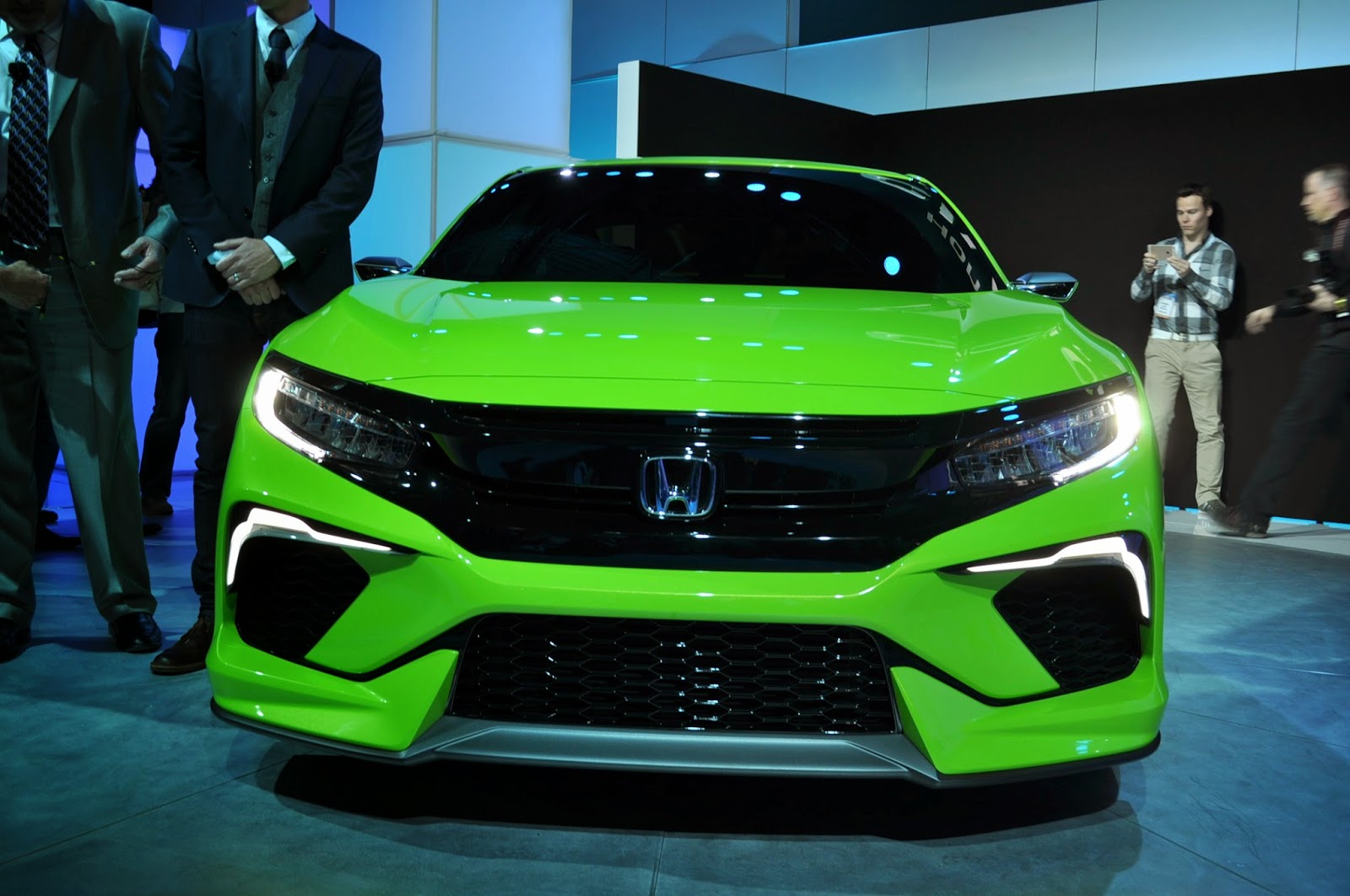


"Charismatic, connected and athletic, our goal was to create a design that is emotional and sporty yet with a sense of timelessness and simplicity," said Guy Melville-Brown, Chief Exterior designer of the Civic concept, Honda R&D Americas, Inc. "In this we set out to create a vehicle that goes beyond the superficial and embraces the very philosophy of what a true Civic should be; it's a real game changer."
The 10th-generation Civic is based on a compact platform that targets benchmark levels of efficiency, dynamic performance, safety and manufacturing productivity. Leveraging this new platform in conjunction with new Earth Dreams Technology™ powertrains – including a new 1.5-liter VTEC® Turbo engine with direct injection, a short-shifting 6-speed manual transmission, and a new, more sporty and efficient continuously variable transmission (CVT) – the Civic will target class-leading fuel economy ratings and fun-to-drive performance with near-luxury levels of cabin quietness and ride refinement.
The new Civic will also target class-leading levels of safety performance and will offer the Honda Sensing™ suite of advanced safety and driver-assistive technologies, including Lane Departure Warning, Forward Collision Warning, Multi-Angle Rearview Camera, Adaptive Cruise Control and Honda LaneWatch™, along with Honda's next-generation Advanced Compatibility Engineering™ (ACE™) body structure.


Honda is in the midst of a series of major product launches that began with the freshened CR-V – 2015 Motor Trend Sport Utility of the Year – and continues with the spring launch of the all-new 2016 Honda HR-V crossover and the summer launch of the redesigned 2016 Honda Pilot SUV. This will be followed by the new Civic release beginning this fall.
Mazda MX-5 Club (2016)

We're not going to lie to you. The reason you're seeing the fourth-generation Mazda MX-5 Miata on these pages again is solely because this is the first time we're seeing the roadster displayed in a color other than the ruby shade it was first shown in.

Okay, okay, so this is the first time the Miata is being displayed at
a North American auto show other than SEMA, and we'd say that this is
the first time Mazda
is showing a US-spec model, but clearly this is a right-hand-drive car.
Either way, there's still not much to it yet, especially since Mazda is
still withholding power and performance figures.
As expected, the
ND Miata, as it is already known among the cognoscenti, will receive a
2.0-liter Skyactiv four-cylinder and the buyer's choice of a six-speed
manual or a six-speed automatic here in the US. The 1.5-liter model
engine that had been linked to the car back in the rumormill stage will
not make it to our showrooms.
Preliminary specifications still
show the Miata measuring just 154.1 inches in length overall, with an
increased track width to 68.1 inches and a low, low overall height of
49.0 inches. Despite the larger-displacement engine and its presumably
heavier weight, Mazda is still claiming ideal 50:50 weight distribution
and a weight loss of over 220 pounds versus today's NC generation. All
of which sounds like the Miata has the right ingredients to make good on
its promised Jinba Ittai ("rider and horse as one") driving experience.
It might be just plain ol' white paint, but you can color us excited.


Audi R8 e-tron (2016)
The new R8 e-tron is indeed a real thing!
After the last
model was cancelled in near-production form — despite years of testing
and R&D — the R8 e-tron was never a sure thing for this generation.
Audi is indeed selling this new R8 EV to customers — with orders taken later this year.
Performance
is quite slow versus the Tesla Model S. The R8 e-tron hums its way to
62-mph in 3.9-seconds before hitting a Vmax of just 153-mph. Overall
range when driven gently is more than 250 miles.
The design is
massaged nicely with a grille inset in carbon-fiber, added lower bumper
detailing and an extra LED element forming a vertical line in the edges
of the nose.
Slight tweaks to the side blade intake and a sharper rear spoiler are the other big e-tron changes.
Oh, did we forget the solid wheels and the absolutely hideous, revolting whitewall tires?
Absolute nightmare. Who chose whitewall tires, and why? Disgusting.
Overall,
the R8 e-tron will be an extremely rare and extremely pricey upgrade
over the gasoline R8. Double the price for half the performance?
Perhaps 100 of the R8 e-trons will find homes starting in Spring 2016.
Despite being silly, the R8 e-tron does have one big asset in its favor: it is the only rear-drive R8.


The second generation of the Audi R8 forms the basis for two more
models. Audi has made major engineering developments in its
high-performance electric sports car, the R8 e-tron. The latest
evolution of the vehicle takes up the multimaterial Audi Space Frame
from the new series-production model.
The supporting
structure was enhanced by a CFRP rear-section module comprising the
luggage compartment. The walls of the CFRP luggage compartment well are
corrugated. This way, in the event of a rear-end collision, more energy
can be absorbed despite the reduced material weight.
Thanks
to targeted modifications to the outer shell and on the wheels, the
Audi R8 e‑tron achieves an aerodynamic drag coefficient (cd) value of
0.28. In terms of performance and range, the car enters entirely new
dimensions.
The large T-shaped battery is structurally
integrated into the center tunnel and behind the occupant cell –
optimally positioned in the car. It supports the dynamics of the R8
e-tron with its low center of gravity. Audi produces the high-voltage
battery itself, for the first time based on a newly developed
lithium-ion technology which was specially conceived for a purely
electric vehicle drive. In comparison to the first technology platform,
the battery capacity has grown from 49 kWh to approximately 92 kWh. This
progress was possible without changing the package.


The power is now twice 170 kW and the maximum torque twice 460 Nm (339.3 lb-ft). The R8 e-tron accelerates from 0 to 100 km/h (62.1 mph) in 3.9 seconds on its way to an electronically restricted top speed of 210 km/h (130.5 mph) or 250 km/h (155.3 mph). Intelligent energy management and an electromechanical brake system enable high energy recuperation rates. Targeted torque vectoring – needs-based distribution of power transmission between the rear wheels – ensures maximum stability and dynamism.
Audi uses the electrical high-performance sports car primarily as a mobile high-tech laboratory. Accordingly, the findings from the R8 e-tron help in creating a vehicle with a sedan character. Upon customer request, the R8 e-tron will be available for order in 2015 as an electrically powered sports car in supreme hand-built quality.


.jpg)

